Showing posts with label wall street journal. Show all posts

Tuesday, March 10, 2009

A Glimpse of March 10th's Economic News

Latest news from the New York Times:
Madoff to Plead Guilty; Charges Carry a Life Sentence

New York Times Graphic:
Where Madoff Found Investors

The Wall Street Journal
Dow Surges Nearly 6%

[Stocks Surge]
Picture from Associated Press

The following videos were removed:

Just the Right Medicine for Uncertain Times

Thar's Green in Them Thar Gold Stocks

Tuesday, January 20, 2009

Economic Updates: WSJ's Madoff Interactive Graphic; "Sins of Omission" regarding BofA-Merrill & the US Government


The above picture will link you to the Wall Street Journal's interactive graphic, "Madoff's Circle of Friends". The larger circles represent larger investors. Mousing over the circles and dots will provide more information.

Related Article
Family Filled Posts at Industry Groups

Video
US Government: BofA-Merrill Matchmaker or Godfather? (Dennis Berman and Evan Newmark)


The main question asked in this video: Just what is going on with Bank of America?
Sins of commission, sins of omission?


"WSJ's Dennis Berman says the Bank of America and Merrill Lynch merger is raising questions about the government's role during negotiations. He tells colleague Evan Newmark its apparent actions conflicted with shareholders' rights."

Saturday, January 17, 2009

The End of Wall Street as We Know It: Compelling 3 part on-line video introduction to the WSJ book by David Kansas

The following three videos are from the Wall Street Journal's website and are adapted from the book, The Wall Street Journal Guide to The End of Wall Street As We Know It, by David Kansas. The book, published by Collins books, will be released in paperback on January 27, 2009. The Kindle Edition is currently available.

Below each video, I've added some quotes and paraphrased some of the content. (I wasn't able to get the names of some of the people quoted from the videos.)

You'll have to buy the book to catch it all.


End of Wall Street: What Happened
(Wall Street Journal, 1/05/09)

Chapter One:

"In the first of this three-part series, Journal reporters explain how the housing bubble inflated and burst, and why easy money led to the collapse of Wall Street's biggest financial institutions"


The push for home ownership from the government led Fannie Mae and Freddie Mac to lend home loans at lower rates than others. Banks tried to follow suit, in order not to lose market share, and look for ways to make money, such as offering sub-prime mortgages, which were offered to people with a higher risk, at a higher rate than prime mortgages.

To make more money, banks developed a strategy of "mortgage bundling", which in theory, would reduce the risk if a few of the mortgages weren't being paid. The bundles then were traded back. and forth. According to the WSJ video, these bundles were really like poisoned sausages.

In 2002, the Federal Reserve reduced short term lending rates to 1%, known on Wall Street at easy money. "All of the constraints seemed to go out the window". It was easy for everyone to borrow money and rely on credit cards. This period of easy money went on into 2007. People were qualified for large mortgages for homes that they should not have been allowed to purchase, given their incomes.

Investment banks found that they could rely on large amounts of borrowed money to finance their operations. This resulted in a surge of growth in Wall Street, and a growth in the amount of debt (leverage). New ways of dealing with investments emerged that were complicated to understand. These strategies and deals, on the surface, made Wall Street folks richer than before. The "herd" mentality set in, and the new sophisticated practices, relying on computer modeling to minimize the "risk", became acceptable for the norm.

As the market increased in size, banks came up with even new ways of managing risk. During the late 1990's, JP Morgan developed the concept of credit default swaps, which is insurance on the debt of a company. Once the insurance was purchased, if the company went belly-up, the owner of the insurance would make money. This concept was initially practiced during the 1800's when people laid bets on weather or not a ship would return from sea. People were greedy and sank ships, so friends could collect the insurance.

The same sort of thing happened during the present crisis. Two hedge funds managed by Bear Stearns, a large Wall Street investment company, imploded. Billions of dollars of bonds were sold, and investors demanded to get back cash.


End of Wall Street: Why it Happened
(Wall Street Journal, 1/05/09)

Chapter Two:

"What was going through the minds of CEOs, corporate boards, fund managers and mortgage lenders as they created hard-to-understand derivatives Warren Buffett once called "weapons of financial mass destruction."

"There is plenty of blame to go around. I think in retrospect that lots of people who were doing stupid things." -Alan Murray, WSJ Deputy Managing Editor

"..The regulators did not keep a careful eye on what was happening on Wall Street. Indeed, in some cases, they looked the other way. The regulators were too interested in watching Wall Street succeed in going from rich to riches. -Dave Kansas

"The purpose of a regulator is to make sure that the banks DO have risk controls, and that they are aware of what is going on."- Daniel Hertzberg

"Alan Greenspan... believed that complex derivatives, complex investment instruments, were ultimately good, healthy, and safe for the economy. Warren Buffet, the greatest investor in America, said these were weapons of financial mass destruction...After his term, he was called back to congress to testify in relation to the financial crisis. In that testimony, he conceded that perhaps he had been wrong about derivatives and the need for greater regulation in the financial system." -David Kansas

"...so the things we got wrong were not details. The things we got wrong were major checks and balances and safety valves in the global financial system." -David Wessel, WSJ Economics Editor

"The story of the credit rating agencies is a story of a colossal failure"
-Henry Waxman, House Oversight Committee Chairman

"There were huge failures of the ratings agencies, who clearly didn't understand what they were giving triple A ratings to, because suddenly they don't have triple A ratings any more, and that is a huge failure..."

(Banks stopped lending money. The economy basically stopped.)

"At some point, there needs to be a longer term solution. We're still in crisis management mode. They haven't even started to figure this thing out, but the entire financial architecture is going to have to be reconsidered as a result of what we've just been through."

End of Wall Street: What Happens Next (Wall Street Journal, 1/05/09)
Chapter Three:


"This final chapter of the crisis on Wall Street tells the story of the $700-billion bailout, as seen through a reporter's eyes, and looks at what's ahead for the global economy."

"You have the destruction of the US financial industry. People don't want to say it, but, it's been destroyed."

"...This is one of the reasons why the calamity was so severe, because everyone had the same bets going on at the same time."

"We've come to believe all these things about the institutions in our country, that is supposed to give you a sense of well-being or confidence, but the financial system has failed us. The governmental system that is supposed to regulate, oversee this, direct this financial system utterly failed us. We as individuals took as much money as we could, as fast as we could, in a way that has failed the country."

"For too many years, people borrowed too much, spent too much, lived beyond their means, and the time of reckoning has come, too all of us."

"I think we've been living in a consumer-debt driven era for quite a long time."


RELATED:


Interview of Dave Kansas, Amazon Kindle's Blog

Tuesday, January 6, 2009

Germany's "Warren Buffet", Billionaire Adolf Merckle, Commits Suicide - Update to the Hedge Fund Drama about Porsche & VW stock options

On October 30th, I posted about my confusion about hedge funds and shared a link to an interesting article in the Economist: "Porche and VW - Squeezy money: How Porsche fleeced hedge funds and roiled the world's financial markets"

Well, I am still confused, and saddened. Much has unraveled since that post. Last month, it was Bernie Madoff and the non-existent funds of philanthropic organizations that must close operations, resulting in negative consequences for many.

German billionaire Adolf Merckle's recent suicide adds to the drama.

http://images.forbes.com/media/lists/10/2006/2ORL.jpg

Mr. Merckle was known as Germany's "Warren Buffet". He was a well-respected man who was involved in the short squeeze on hedge funds, orchestrated by Porsche.

Here is the initial information, from the Wall Street Journal, via the Associated Press:

"BERLIN -- The family of Adolf Merckle said the German billionaire committed suicide after his business empire got into trouble because of the global financial crisis.

A brief family statement Tuesday did not give details on the circumstances of the 74-year-old investor's death. It said the problems his holdings suffered due to the financial crisis "broke" him and "he ended his life."

Mr. Merckle's business interests included drug maker Ratiopharm International GmbH and cement maker HeidelbergCement AG.

The newspaper Die Welt reported that Mr. Merckle was struck by a train near Ulm, Germany and died Monday night."

"Mr. Merckle has recently been in the news with reports that he lost money in transactions involving Volkswagen AG shares when the company's stock surged at the end of October."

—Dow Jones Newswires contributed to this story. Copyright © 2009 Associated Press

Mr. Merckle's money was involved in hedge funds involved in short selling- betting that VW's stock would go down, but lost money when it went up instead.

Update:

"The plight of his firms caused by the financial crisis, the uncertainties of recent weeks as well as the powerlessness of not being able to do anything, broke this passionate family businessman and he ended his life," a statement said.

Merckle, 74, headed the world's 94th biggest fortune, according to Forbes magazine, with a total net worth last March of $9.2 billion." - Wealth Bulletin

'Broken' Billionaire Merckle Killed Self, Family Says
(Bloomberg)

Here is an excerpt from my earlier post about hedge funds, short selling, VW, and Porsche:


"No matter how hard I try, I still don't quite understand hedge funds.

According to an article in today's Economist (10/20/08), "hedge funds sold shares in VW that they did not own." From what I can tell, companies such as Morgan Stanley and Goldman Sachs and the likes might have "exposure" to VW. There is no telling, right?!

I guess if things were transparent, the general public might have a better idea of what is going on, and perhaps have a better chance of making better data-driven financial decisions. Right now, people are third-guessing. What a game the world has been playing!

From the article:

"Adam Jonas of Morgan Stanley warned clients on October 8th of the danger of playing “billionaire’s poker” by betting against Porsche."

That sounds about right.
Yes.
Billionaire's Poker.
"

RELATED

Billionaires' lustre dims as crisis grips -Reuters 12/30/08, Via Guardian

Merckle’s VEM Investment Unit Says Bank Claims Frozen (Update2) -Bloomberg 12/30/08
"Adolf Merckle, whose holdings span the cement, machinery and drug industries, was battered by wrong-way bets on Volkswagen AG, a drop in the value of his HeidelbergCement AG stock and increasing debt at his companies. The 74-year-old, whose estimated $9.2 billion fortune put him 94th on Forbes’ list of the world’s richest people, had previously threatened to seek insolvency for VEM if banks didn’t provide financing."

FACTBOX - German billionaire Merckle's business conglomerate -
Thomson Financial News 1/6/09

"Porche and VW - Squeezy money: How Porsche fleeced hedge funds and roiled the world's financial markets" (This article is a must-read, along with the comments.)

"Porsche crashes into controversy in the ultimate 'short squeeze'"

""This is the culmination of long-held plans to take over VW. Porsche engineered the squeeze as one of the most brilliantly conceived wealth transfers ever: they've got the hedge funds positioned to pay for Porsche's acquisition of VW. The only thing they underestimated was the scale of the fallout," said an insider
."

The Madoff Economy (New York Times Op-Ed, Paul Krugman, 12/19/08)

Saturday, December 13, 2008

From Ponzi to Madoff: Interactive Graphic from the Wall Street Journal

Here is the link:

From Ponzi to Madoff

"The arrest of investment manager Bernard Madoff for allegedly running an ongoing $50 billion swindle is the latest scam of the kind made famous by Charles Ponz in the 1920's. In these schemes, early participants are paid returns from the principle received from later and different investors." -Wall Street Journal

Saturday, October 25, 2008

Massive Declines All Around the World; Wall Street Journal Video - Analysis of World

Is it impossible for experts to model the current state of the world economy?

For a few insights about the current global economic situation, take a look at the video analysis with Andy Jordan and Tom Lauricella from the Wall Street Journal below.

Are there glimmers of hope in this massive decline of global markets? How can we really know?


Market Mush


Related
WSJ Interactive Graphic of 10/24/08 Market Dynamics:
Tough Session: Stock declines started in Asia and quickly spread as markets opened for trading around the world

WSJ Article -10/25/08:
Fresh Tumult as Signs of Recession go Global
(Kelly Evans, Joellen Perry,Yumiko Ono and John Lyons)
"In rich countries and poor countries alike, markets are plunging, companies are scrambling for credit and cutting their growth plans and consumers are keeping cash in their pockets. The U.S. and some governments in Europe and Asia are spending heavily to stanch the problems in markets and Main Streets globally, but the attempts have not halted the damage."

Monday, October 13, 2008

Wall Street Journal and New York Times Online: Treasure Troves for Economic and Financial Info

The on-line versions of the Wall Street Journal and the New York Times are great resources for information, current and historical, about economics and finance. In addition to what you find in the print, you will find a variety of interactive charts, photos, and video clips.

Here are few interesting links:
(Note: Some videos may contain ads.)

Wall Street Journal
Wall Street Journal's Interactive Graphics (This site contains interactive graphics about business, the economy, finance, politics, and more.)
Kashkari Gives 'Comprehensive Update' on Rescue Plan (full text from Interim Assistant Secretary for Finance)
Tumbling Stocks, Plunging Currencies (Interactive map depicting information about the major stock index and currency of various countries over the past three months.)
Bears That Won't Go Away (Chart)
What History Tells Us About the Market (10/11/08 -Article with photos)
IMF Pledges Support, but Is Short on Details (10/12/08 - Video; Analysis by WSJ Reporter Bob Davis)


New York Times
Podcast: Weekend Business (10/10/08)
Kashkari Details Rescue Plan (10/13/2008) (CNBC Video, linked from NYT online)
Echoes of a Dismal Past (Video)
How This Bear Market Compares (interactive chart, depicts losses and in length, over the past 80 years)
Credit Crisis Indicators ( interactive chart, depicts 3-Month Treasury, Libor, Ted, Paper, & Bonds)

Wednesday, October 8, 2008

Gordon Gekko, Wall Street, and Behavioral Finance

1987 was not a very good year for the U.S. economy. The "Go-Go '80's were fueled by a touch of greed. Nothing explains this better than the following clip of Gordon Gekko, a fictional corporate raider played by Michael Douglas in the movie Wall Street. Gekko firmly believed that greed is good. Ironically, the events in the movie forshadow the scandals that have been played out on Wall Street and corporate America over the past 21 years. Below is a quote from Gekko's speech, and the corresponding video clip I found on YouTube.

"The point is, ladies and gentlemen, that greed, for lack of a better word, is good. Greed is right, greed works. Greed clarifies, cuts through, and captures the essence of the evolutionary spirit. Greed, in all of its forms: greed for life, for money, for love, knowledge, has marked the upward surge of mankind". - Gordon Gekko (Memorable Quotes from Wall Street)


(I will take down this video if I'm notified that it violates someone's copyright.)

Humans are complex creatures. It would be challenging to create a behavioral finance application that could account for and predict various psychological and sociological scenarios. What would represent a constant? What characteristics, traits, behaviors, and inclinations would play as variables?

Here are a few:
Perhaps "greed" is an important human factor that should be incorporated into this affective/behavioral/financial applications. There are quite a few more:

"herd mentality", "politics", "power", "control", "need for constant adrenaline rush", "sins of omission", "sins of commission", "consumer confidence", "illusion of stability", "cluelessness", and of course, "
truthiness".

I don't intend this to be a joke. In real life, this would be a serious endeavor. I am not sure that Wall Street quants would try to figure ways to quantify the concept of truthiness.

Behavioral Finance Resources

Behavioral Finance: Benefiting from Irrational Investors
(Julia Hanna, Harvard Business School)
"Behavioral finance replaces the traditional and idealized idea of rational decision makers with real and imperfect people who have social, cognitive, and emotional biases. The resulting inefficiencies in the capital markets can create opportunities for investment managers and firms."

Behavioral Finance: A Review and Synthesis pdf
(Avanidhar Subrahmanyam, 2006)

The Behavioral Finance Hoax pdf
(Richard Michaud)

Detailed presentation, includes theories and formulas:

A Survey of Behavioral Finance
(Nicholas Barberis, Richard Thaler, presented by Ryan Samson, CalTech)

Behavioral Finance at JP Morgan

(Malcolm P. Baker, Aldo Sesia Jr. 2007, Harvard Business Publishing)

Did we for get the lessons learned from Enron?

Did we forget the lessons from Enron?
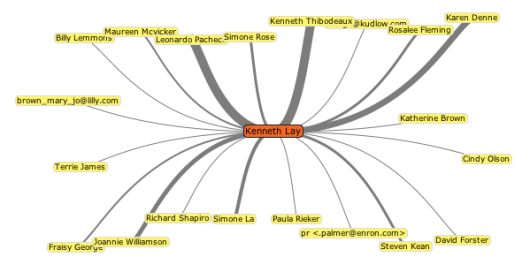
There was quite a bit of publicly available information around related to the Enron fiasco in 2001. Available on-line is the Enron Explorer e-mail visualizer, which was created from the database of all of the email messages between Enron's senior management team as things were falling apart between 1999-2002.
http://flowingdata.com/wp-content/uploads/2008/03/enron-explorer.png


http://www.visualcomplexity.com/vc/images/599_big01.jpg
visualcomplexity.com

The following NY Times article (February 2002) will refresh your memory: Enron's Many Strands: The Company Unravels; Enron Buffed Image to a Shine Even as it Rotted from Within

Punishment was not swift, as the trial ended in 2006:
Two Enron Chiefs are Convicted in Fraud and Conspiracy Trial (NY Times, 2006)

"... the executives had sanctioned or encouraged manipulative accounting practices and then crossed the line from cheerleading into outright misrepresentations of financial performance."

"Enron's fall had a far greater impact than on just the energy industry by heightening nervousness among average investors about the transparency of American companies. "The Enron case and all the other scandals and cases that trailed after it may have finally punctured that romance with Wall Street that has been true of American culture for a while now," said Steve Fraser, a historian and author of "Every Man a Speculator: A History of Wall Street in American Life."

Wall Street Journal's Interactive Graphics: Cracked Foundation; Housing Pain


Cracked Foundation is an interactive graphic that compliments an article in today's Wall Street Journal. A quick look at the first graph will tell you the scope of the problems facing the most hart-hit regions, in a way that words can not.

This is an example of visual information that would be useful in a interactive multimedia time-line.


October 8, 2008
Housing Pain Gauge: Nearly 1 in 6 Owners 'Under Water" (James R. Hagerty and Ruth Simon)
"More Defaults and Foreclosures Are Likely as Borrowers With Greater Debt Than Value in Their Homes Are Put in a Tight Spot"